Disclaimer: This article provides general safety guidance only. If you or anyone else is in immediate danger, call 000 before anything else.
Key Takeaways / TL;DR
- Turn on your hazard lights and pull as far to the left as possible the moment something feels wrong with your car
- On a freeway or high-speed road, stay buckled inside your car and do not exit onto the shoulder
- Call 000 if you are in immediate danger, or your roadside assistance provider if you are safely off the road
- Under Road Rule 79A, approaching drivers must slow to 40 km/h when passing a stationary vehicle displaying hazard lights
- A well-stocked car emergency kit in your boot can make the difference between a quick fix and a long wait
- A vehicle breakdown can be a stressful experience, but having a plan before it happens makes it manageable
Car Just Died on You? Here’s What To Do Next
There’s a very specific moment when you realise your car isn’t going to make it.
Maybe you’re climbing onto the Monash and it starts losing power, or the lights just stalls, or maybe the warning lights suddenly flood the dashboard.
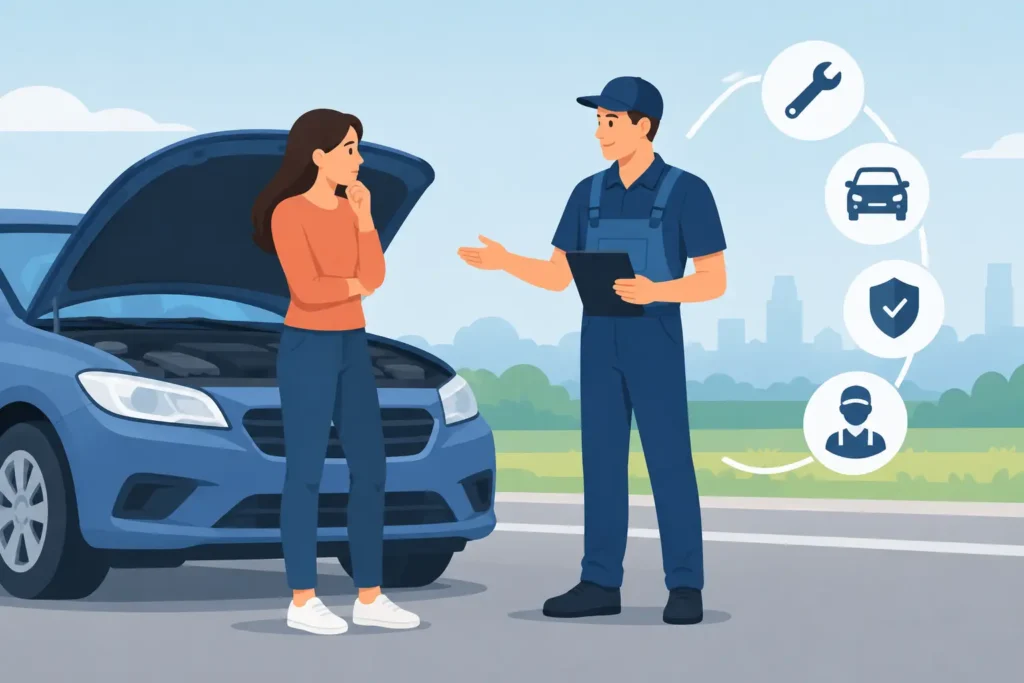
A breakdown can be a stressful experience no matter where or when it happens.
And nine times out of ten, the stress isn’t just the breakdown, it’s also not knowing what to do next.
So here it is, practical, calm advice from someone who attends real vehicle breakdown jobs across Melbourne every day.
Step 1: Get Left and Get Safe
If the car is still moving:
-
Turn on your hazard lights immediately.
-
Signal and pull over to the side.
-
Move as far to the left and away from traffic as possible.
-
Try to get the vehicle off the road completely.
On high-speed roads like the Eastern Freeway, CityLink, Princes Freeway or the Hume Highway, even half a metre further left makes a difference.
If your vehicle completely loses power and you cannot clear a live lane:
-
Stay inside.
-
Keep your seatbelt fastened.
-
Call 000 immediately.
-
Explain your exact breakdown location.
According to Australia’s National Road Safety Data Hub, secondary crashes, meaning crashes occurring after an initial incident, are a significant contributor to serious road trauma each year. The mechanical fault itself is rarely the biggest danger. Traffic is.
Always prioritise safety first.
Step 2: On a Freeway, Stay Inside the Vehicle
This is one of the most important points.
If you break down on a freeway or any road where traffic exceeds 80 km/h:
Stay buckled inside your car.
Your vehicle provides more protection than standing beside it on a shoulder with trucks passing at 100 km/h.
Only exit the car if:
-
There is smoke or fire,
-
You are directed by police or emergency services, or
-
You can safely leave from the passenger side away from traffic and move behind a barrier.
On quieter suburban streets, it may be safer to step out and stand a safe distance away from the vehicle, but always judge based on traffic flow.
Every vehicle breakdown scenario is different. The constant is creating distance from moving traffic.
Step 3: Make Your Car Visible
Hazard lights stay on the entire time.
The 40 km/h rule: know it before you need it
Under Victorian Road Rule 79A, any driver approaching a stationary vehicle with hazard lights flashing must slow to 40 km/h. In July 2025, this was extended to cover breakdown towing trucks and roadside assistance service vehicles as well.
It applies across Victoria, and similar laws exist in every other state. If you are sitting in a broken-down car with your hazards on, the law is actively protecting you.
That said, do not rely on other drivers to always notice.
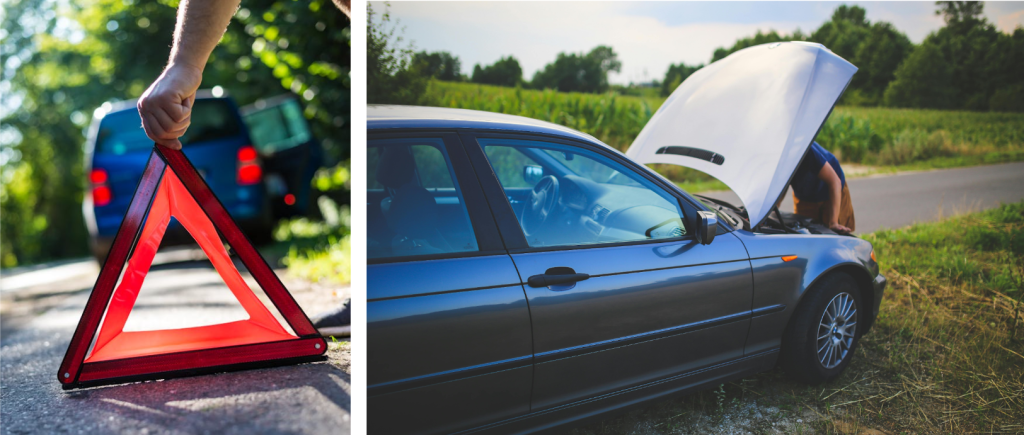
Once you are stationary in a safe location, if you have road safety triangles or LED flares in your boot, place them behind your vehicle. On a road with a 100 km/h or 110 km/h speed limit, place them at least 150 to 200 metres behind the car to give approaching drivers adequate warning distance.
At night, leave your interior cabin light on in addition to your hazard lights. If you have a high-visibility vest, put it on before stepping outside the vehicle.
Step 4: Decide — Roadside Fix or Tow?
After attending hundreds of breakdowns across Melbourne, the most common car breakdown causes I have observed are:
-
Flat or damaged tyres
-
Dead or ageing car battery
-
Overheating
-
Electrical faults
-
Fuel miscalculations
If you are completely well off the road, you can check basic issues safely.
Flat tyre
Flat tyres are one of the most frequent breakdown scenarios across Melbourne, particularly on roads with rough surfaces or construction debris. If you are in a genuinely safe location with a spare tyre, a jack, and a wheel brace, you can change it.
A few things worth knowing: always chock the opposite wheels before lifting the car, and if your car has a space-saver spare, keep your speed under 80 km/h and get to the nearest tyre shop or mechanic as soon as possible. They are not built for extended use.
If you are on a freeway shoulder or anywhere with narrow road shoulders, do not attempt the tyre change yourself. Call for a tow truck operator to come to you. Your safety is worth more than the time saved.
Flat batteries and non-starts
Flat batteries are the single most common reason Melbourne drivers call for help, and they spike noticeably in winter when temperatures drop in the south-eastern suburbs and the Dandenong Ranges. A portable jump starter in your car emergency kit costs under $80 from Repco or Supercheap Auto and can start most standard vehicles up to 20 times on a single charge.
If a jump start does not work, or if the car battery keeps dying after you get it going, the issue may be the alternator rather than the battery itself. That is a case where driving on is not the right call, especially if your car has an older battery that has been showing warning signs.
A flat that will not hold charge after a jump means the car needs to go to a mechanic, not back onto the freeway.
Overheating
In summer, particularly in Melbourne’s north and west where the heat sits longer, overheating is a real risk on longer drives. If your temperature gauge goes into the red, pull over immediately and turn off the engine.
Do not open the bonnet straight away. Wait at least 15 minutes. Never open the radiator cap on a hot engine. The pressure build-up can spray boiling coolant and cause serious burns.
Once the engine is cool, check the coolant level. If it is low and you have coolant in your emergency kit, top it up. If the car overheats again within a few kilometres, it is time to stop driving and call a tow.
Fuel
Running out of petrol happens, especially on longer drives toward places like Healesville, Phillip Island, or the Yarra Valley where servos are more spread out. If your roadside assistance service covers fuel delivery, a small amount of fuel will be brought to your breakdown location to get you to the nearest service station.
Keep in mind that on a freeway, leaving your car to walk to a servo is never a safe option. Stay with the vehicle and call for help.
Step 5: Call for Help — In the Right Order
If you are in danger:
Call 000.
Police and VicRoads incident response can be with you faster than any assistance provider in a live-traffic situation, and they will help manage the scene while you wait.
If safe:
You can call your roadside assistance service if you have one. A roadside assistance provider may be able to fix minor battery or tyre issues.
Many car insurance policies in Victoria include some form of emergency roadside coverage, and drivers often do not realise it until after they have already paid out of pocket. A quick look at your policy documents before you next renew is worth doing.
If your coverage does not include towing, or if the insurer cannot reach you quickly enough, that is where a specialist tow truck service, like Onigo Towing, matters.
We operate 24 hours a day, seven days a week across greater Melbourne, and because we focus exclusively on vehicle breakdown situations rather than accident recovery, we are typically faster to respond for non-accident callouts. Our pricing is confirmed upfront before we dispatch, so there are no surprises when the truck arrives. You can reach us any time on +61 413 432 976.
What to have ready when you call
- Your location: a suburb name, a highway number, or a nearby landmark. If you are unsure, open Google Maps and read out your GPS coordinates
- Your rego plate, and the make, model, and colour of the car
- A brief description of what happened
- Whether you are in a safe location or still near moving traffic
Step 6: What To Do While You Wait for Help
Once you’ve made the call, your only job is to stay safe until help arrives.
-
Keep your hazard lights on – Even if the battery is low, visibility matters more.
-
Keep your phone charged – Use a power bank so you can track your tow ETA and stay contactable.
-
Stay near your vehicle – It makes you easier to find and avoids delays.
-
If you step away, leave something visible – Hazards on, jacket on the roof, anything eye-catching.
Note: Leaving your car unattended for long periods is also worth thinking about from a car insurance perspective. Some insurance policies have conditions around unattended vehicles, so photograph the scene and note the time before you step too far away. -
Document the scene – Take photos and note the time, especially for insurance purposes.
-
At night, stay visible – Keep the cabin light on.
-
Trust your instincts – If someone stops and you feel unsure, you can politely decline and wait for professional help.
Step 7: When the Tow Truck Arrives
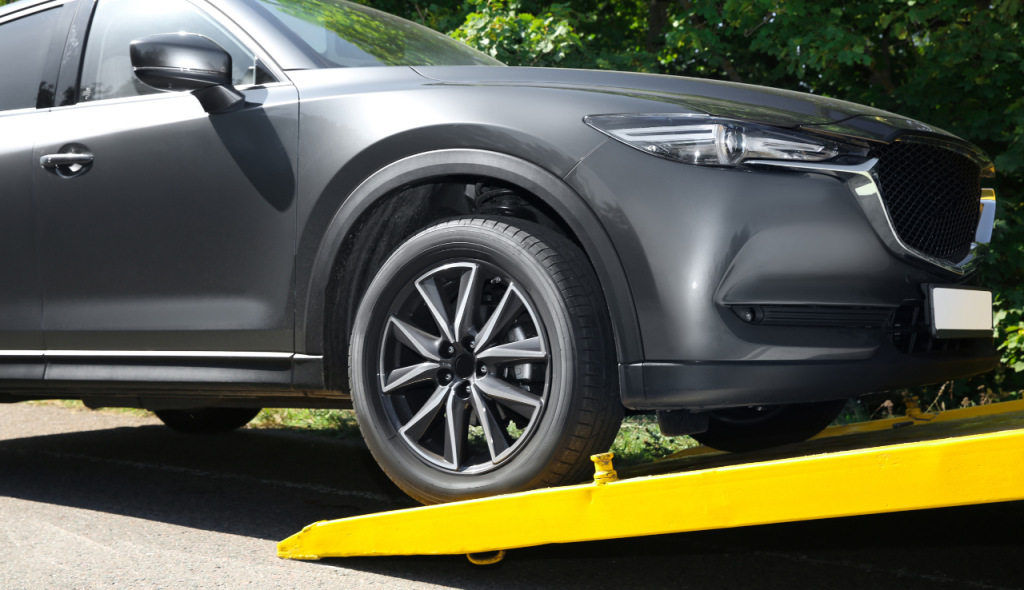
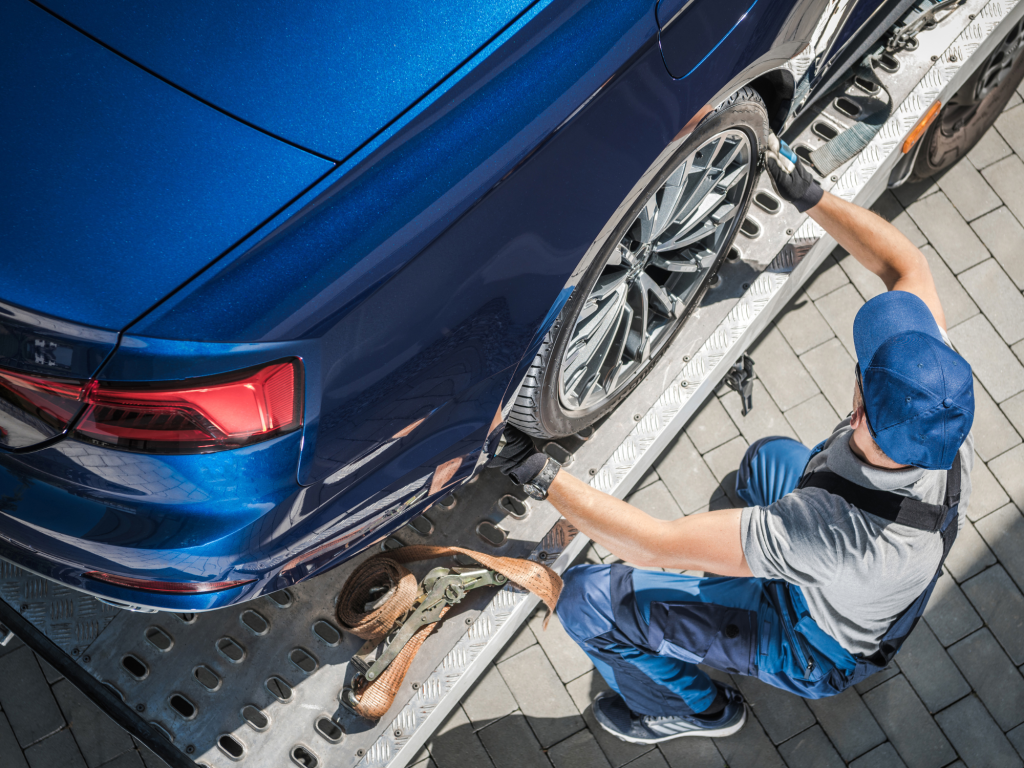
Before the tow truck operator loads the vehicle, take a minute to photograph the dashboard, any warning lights, and the car’s position. This documentation matters if there is ever a dispute with your mechanic, your insurer, or the tow operator.
Confirm three things before the vehicle is loaded: where it is being taken, whether storage fees will start accumulating once it arrives at the yard, and the final total cost. Get this in writing or, at a minimum, repeated back to you clearly over the phone.
When we are called out, we walk through all of this upfront before we even dispatch the truck. The cost is confirmed, the destination is agreed, and the process is clear.
If the car needs specialist handling, like a Tesla, a BYD, or any electric or hybrid vehicle that requires flatbed loading rather than wheel lift, that is worth flagging when you call. We carry the right equipment for EVs and hybrids as standard, which is not always the case with general towing operators.
For Melbourne drivers, we are a phone call away: +61 413 432 976, around the clock, seven days a week.
Building Your Car Emergency Kit
One of the simplest ways to help prevent a car breakdown turning dangerous is preparation.
A basic car emergency kit should include:
- Portable jump starter or jumper cables
- Reflective warning triangles or LED road flares
- High-visibility safety vest
- Torch with spare batteries
- Basic tool kit: screwdrivers, pliers, zip ties
- Duct tape
- Phone charger or portable power bank
- At least two litres of water (more for summer or long drives)
- Non-perishable snacks
- Thermal blanket, especially for winter driving in the Dandenongs or alpine areas
- First aid kit
- A printed copy of your car insurance details and roadside contact numbers
Prepared drivers handle breakdowns better. That’s just reality from years on the road.
Prevent Breakdowns Before They Happen
-
Stay on top of basic maintenance.
Most non-accident vehicle breakdowns are preventable with regular checks. The most common causes — flat tyres, flat batteries, and engine faults — usually give warning signs before they leave you stranded. -
Check your tyre pressure and tread depth monthly.
The legal minimum tread depth in Victoria is 1.5 mm, but most tyre specialists recommend replacing tyres well before that. A quick check at a service station air pump takes just two minutes and costs nothing. -
Test your car battery once a year.
This is especially important if your battery is more than three years old. Melbourne’s summer heat can accelerate battery wear. Warning signs include:-
The engine turning over slowly in the morning
-
Headlights dimming slightly when you start the car
-
-
Monitor your coolant, engine oil, and drive belts.
These checks take around ten minutes and can prevent a breakdown that costs you half a day — plus a towing bill. While a mechanic will inspect these during servicing, it’s smart to check between services, especially before longer drives outside the metro area.
A Note on Car Insurance and What It Actually Covers
Before your next renewal, check specifically what your policy includes for emergency roadside situations.
The key questions to ask your insurer:
- Does my policy include roadside towing, or just emergency call-out?
- How far will the tow be covered, and what happens beyond that distance?
- Are there any conditions around leaving your car overnight at a workshop?
- Does coverage apply if I am outside the metropolitan area?
Comprehensive roadside cover is worth the small extra cost, especially if you drive regionally. If your policy doesn’t include it (or the cover is limited), keep a standalone roadside provider or trusted towing contact saved in your phone.
Conclusion: The Dos and Don’ts of a Car Breakdown
Here’s a quick recap on the dos and don’ts to keep every drive smooth and worry-free.
Do:
- Signal and pull over to the side of the road as soon as it is safe
- Turn your hazard lights on immediately
- Stay buckled inside your car on high-speed roads
- Use your phone to document the scene before help arrives
- Keep a car emergency kit in your boot year-round
Don’t:
- Try to fix your car on a freeway shoulder or busy road
- Stand behind a broken-down car in moving traffic
- Leave your vehicle and walk along a freeway
- Accept a tow without confirming the cost and destination first
- Forget to check your car insurance policy for roadside coverage before you need it
If you want to be prepared before a breakdown happens, save this article, run through the emergency kit checklist, and put our number in your contacts now: +61 413 432 976. We hope you never need it. But if you do, we will be there.